
NCDAC State Release Authority
NCDAC is the official abbreviation for the North Carolina Department of Adult Correction. The agency operates the state prison system and maintains the Offender Public Information system, commonly called OPI. Its public data includes current and historical state prison, probation, and parole information dating to 1972. NCDAC also operates Community Supervision and works with the North Carolina Post-Release Supervision and Parole Commission.
NCDAC is not the custodian for county jail records. A person held only on a local charge may never appear in OPI. By contrast, a person admitted to a state prison can have an incarceration history, movements, projected and actual release dates, release type, sentence status, and supervision record. The NCDAC Criminal Offender Searches page describes these boundaries.

The official navigation separates general OPI, inmate release, and absconder searches so each query can match the right record type.
Use the NCDAC Offender Search
The NCDAC offender search accepts last name, first name, middle initial, gender, race, birth date, age range, offender number, and status. Use exact identifiers when possible. A common name alone can return several people. For a completed state case, choose All or Inactive rather than limiting results to active records.
- Open OPI and enter the strongest known identifier, ideally the offender number or full name plus birth date.
- Set the status scope to All or Inactive when searching for a past prison period.
- Compare the result’s name, birth information, offender number, and case details before opening a record.
- Read each incarceration period, then compare service status, actual release date, last movement, and release type.
- Check the separate supervision section for an active office or post-release status.
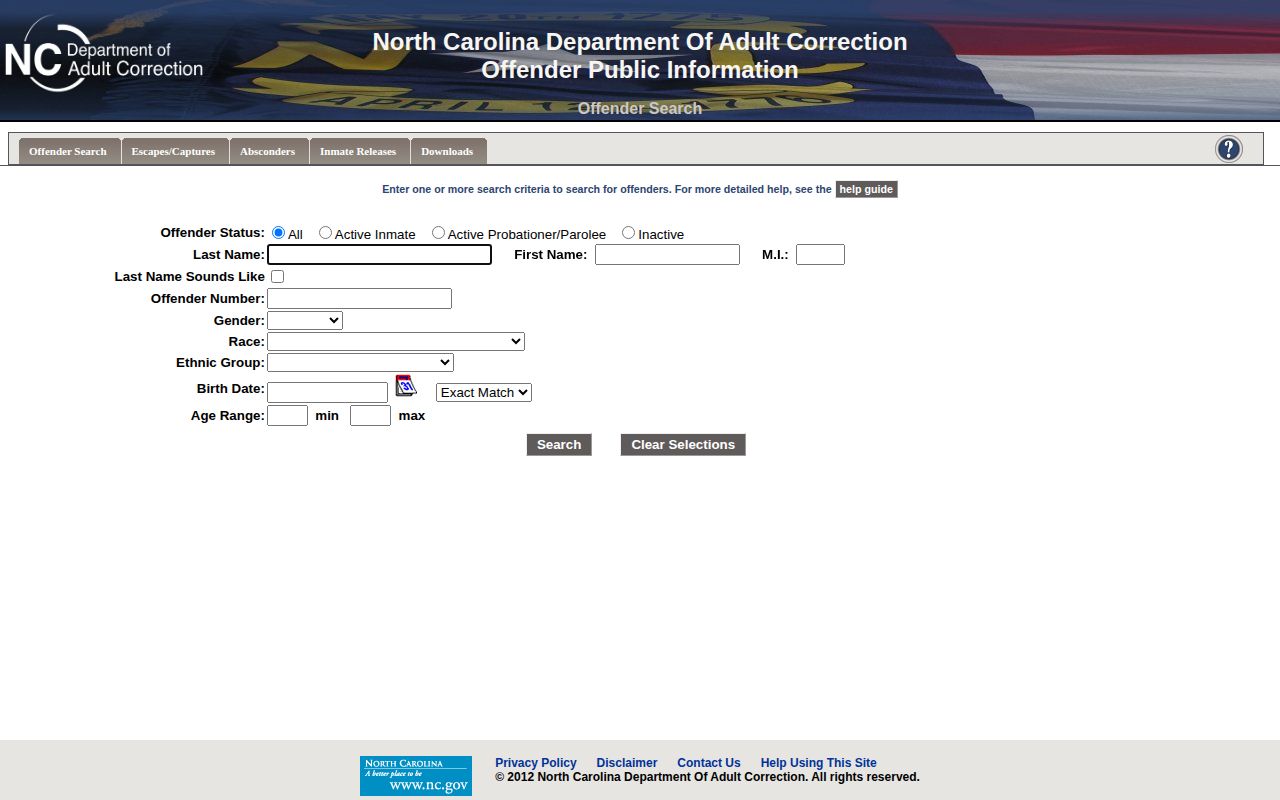
The form’s status filter is crucial because a finished incarceration may not appear in a search limited to active people.
NCDAC Released Inmate Search
NCDAC also provides an Inmate Release Search built for past exits. It can search by county, year, month, or name. Results include a release date, primary offense, and type of release. This route is useful when the event window is known but the full OPI record has not yet been found.
The released-first tool does not replace the full history. Open the matching OPI record and reconcile the release with the relevant incarceration period. A release to post-release supervision is a departure from prison, yet it is not the same as full discharge. A transfer to another authority is not community release at all. Save the access date and exact wording rather than paraphrasing all exits as released.
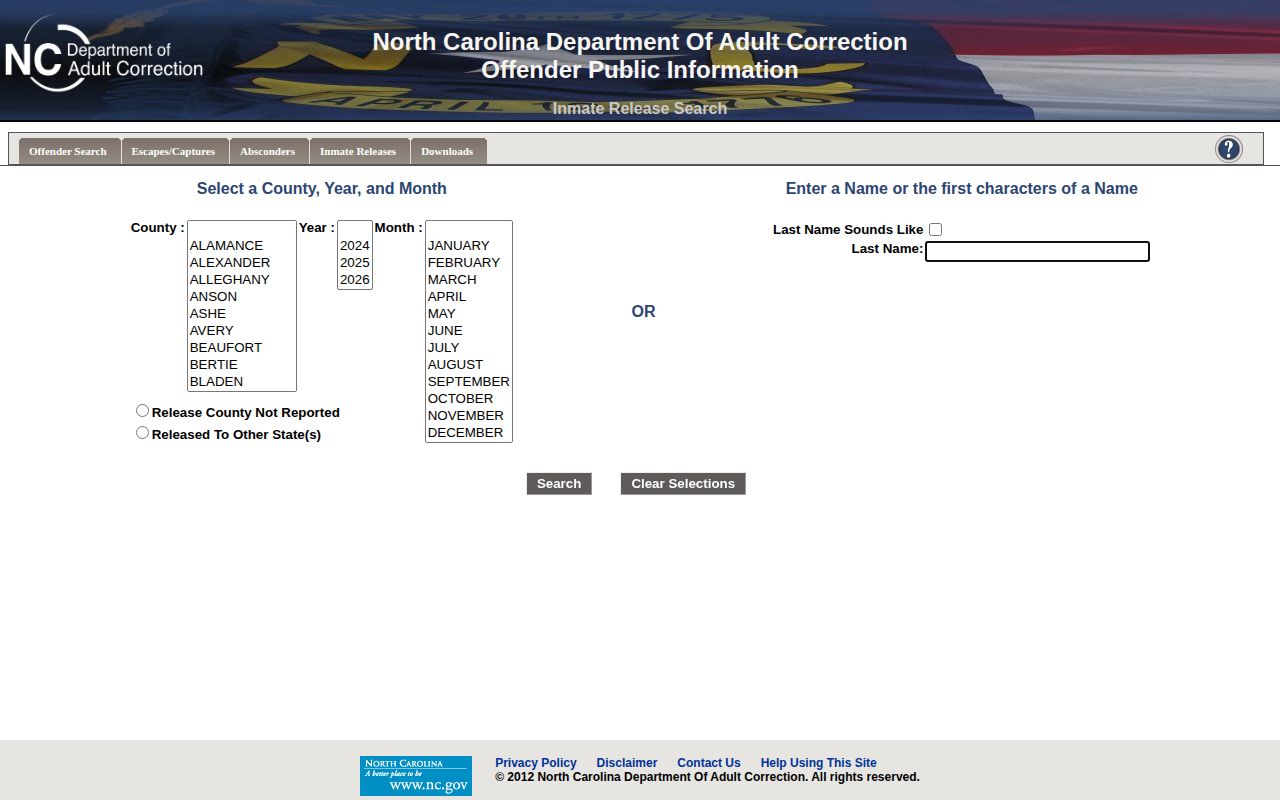
The county field refers to NCDAC’s release-search data, not a complete search of all sheriff jail releases in that county.
A result should be preserved with enough context to be checked later. Note the offender number, release date, primary offense, release type, and access date. Then compare the person’s full OPI history. If OPI identifies active probation, parole, or post-release supervision, the prison exit occurred before final discharge from state supervision. If the service period says EXPIRED, confirm whether another period or case is active before describing the full state record as complete.
NCDAC Offender Search Release Fields
A sound reading uses several OPI fields at once. The offender number identifies the state record. Incarceration and service fields describe a specific period. Projected Release Date is forward-looking. Actual Release Date records a past event. Inmate Status may show POST RELEASE/PAROLE while supervision remains active. A completed period may display EXPIRED, but another incarceration, probation, parole, or hold can still exist elsewhere in the record.
| OPI field | How to read it |
|---|---|
| Offender Number | Stable NCDAC identifier used to separate similar names |
| Inmate Status | Current label for the selected state record, including POST RELEASE/PAROLE |
| Service Status | Whether the listed service period remains active or has EXPIRED |
| Projected Release Date | Current estimate that may change |
| Actual Release Date | Historical exit date for that incarceration period |
| Last Movement | Movement event that helps distinguish release from transfer |
| Probation/Parole Office | Local office tied to active supervision |
Read the full history: One actual release date proves one recorded exit. It does not by itself establish that all sentences and supervision have ended.
NCDAC Release and Discharge Rules
North Carolina’s main state-prison exits include expiration of sentence, release to post-release supervision under Structured Sentencing, and parole for eligible older-law or Safe Roads Act cases. Probation differs because a court orders it, often instead of imprisonment. Parole is a discretionary early release for an eligible case. Post-release supervision is the statutory phase after the prison portion of many current felony terms.
Article 84A governs post-release supervision. Section 15A-1368.2 ties the release point to the imposed maximum term, the applicable supervision subtraction, and earned time. Conviction date, offense class, consecutive terms, confinement credit, forfeited earned time, revocation, and registration duties can matter. Public OPI data can show the recorded dates, but it should not be used to calculate a new legal date.
Structured Sentencing eliminated discretionary parole for offenses committed on or after October 1, 1994. That line explains why many newer NCDAC releases use post-release supervision while the Commission still reviews older parole-eligible cases. Eligibility never guarantees release.
Earned time operates inside this framework. G.S. 148-13 directs the Secretary to make rules for earning and forfeiting time. G.S. 15A-1340.13(d) addresses felony earned time, while G.S. 15A-1340.20(d) allows no more than four earned-time days per month for misdemeanants. Confinement credit is separately addressed in Chapter 15, Article 19A. Credits can affect the projected point but do not promise a fixed early community release.
The same law supplies a limited release-day rule. G.S. 148-13 authorizes NCDAC rules for cash and clothing at discharge or parole and requires at least $45 cash for a person discharged or paroled after two years or more of incarceration. It does not promise that amount for every shorter stay. Nor does it establish a universal bus ticket, clothing amount, or release-site process.
NCDAC Release Totals Differ
The NCDAC FY 2023–24 Annual Statistical Report counted 20,109 prison releases. It separates expiration, post-release supervision, parole, and other release types, and reports that releases fell after the COVID period before rising. A later assessment counted 19,690 selected expiration-or-release-to-supervision exits in calendar 2024 and warned that one person could contribute more than one exit.
These figures cannot be merged into one year-to-year series. One uses the state fiscal year and the agency’s annual release categories. The other uses a calendar-year assessment and a selected exit definition. Each may count events rather than unique people. A defensible citation preserves the year type, method, and repeat-count warning.
| Source period | Count | Meaning |
|---|---|---|
| FY 2023–24 | 20,109 | NCDAC prison releases in the annual statistical report |
| Calendar 2024 | 19,690 | Selected exits; one person may appear more than once |
The NCDAC About page, accessed August 12, 2026, adds a different snapshot.
Its approximate imprisoned and supervised populations are operational context, not a count of NCDAC released inmates.
Release type matters within the annual total. An expiration ends the recorded term, subject to checking other cases. A post-release-supervision exit moves a person from prison to a statutory supervision phase. Parole applies to eligible cohorts and reflects a discretionary Commission action. A raw total cannot reveal how many people had no supervision afterward, how many were later returned, or how many unique people produced the events. Those questions need the report’s definitions and underlying categories.
NCDAC Discipline After Release
NCDAC changes what discipline detail appears after release. Public infraction names and dates can display while a person is in custody, but the agency says the infraction list no longer displays once the person is released. Investigation details remain confidential. A leaner historical profile is therefore an intentional public-display rule, not proof that no disciplinary event occurred.
This limit also shows why an OPI result is not the complete institutional file. The public search is designed to expose defined offender, sentence, movement, release, and supervision facts. Other material may be confidential or withheld under corrections-specific law. Ask only for an existing releasable record and do not assume that a missing public field never existed.
Public discipline visibility should also be separated from earned-time effects. A projected date can move when earned time is forfeited, but a released profile may no longer display the public infraction list that was visible in custody. The date history and the discipline display therefore answer different questions. For a formal record, use the NCDAC request process and expect confidential investigative or classification material to remain protected.
NCDAC State Prison Releases
NCDAC’s institutions include state prisons with different custody and operational roles. A person may move through more than one institution before release. The last listed facility can help trace the record, yet the statewide OPI history remains the main release source. No statewide research supports a claim that all releases are processed at one release center or through one uniform gate procedure.
The NCDAC Institutions directory identifies official state facilities.
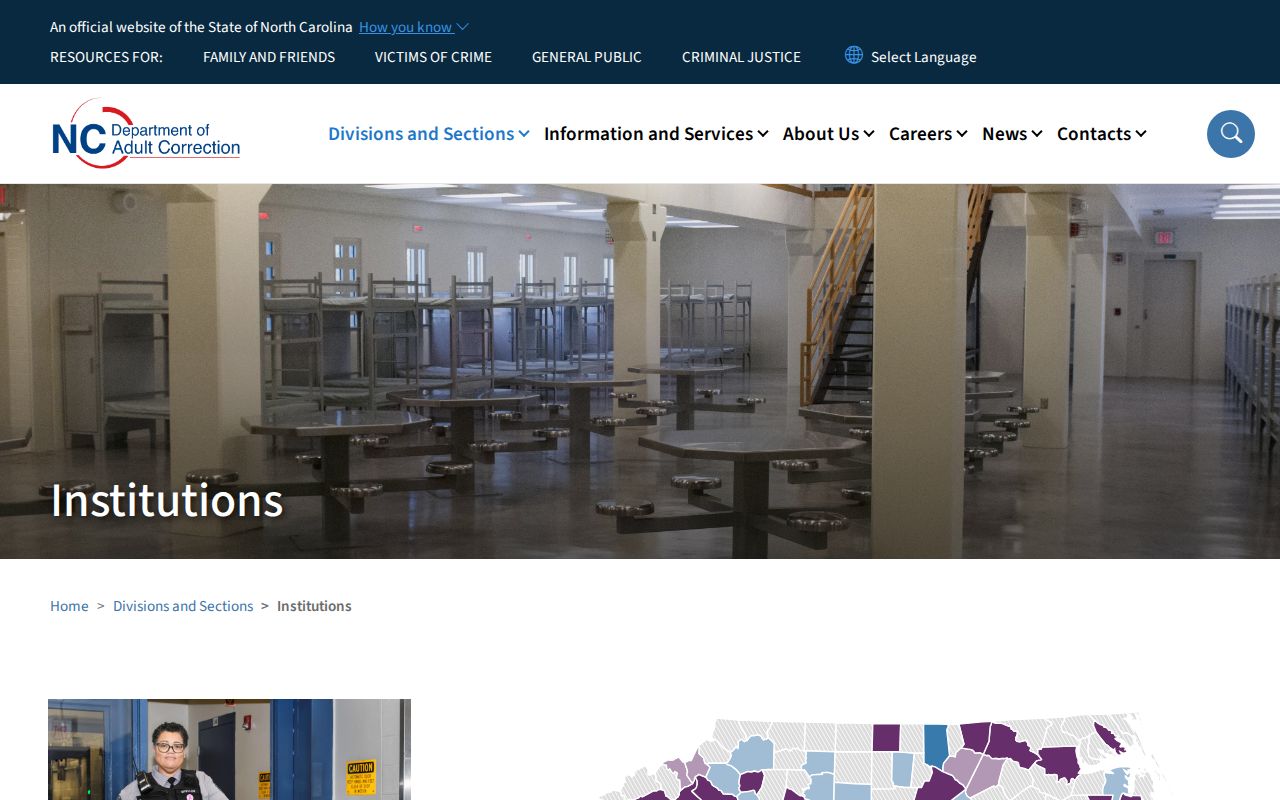
The statewide Facility Directory also includes researched county jails, regional jails, state prisons, federal sites, juvenile facilities, and closed sites with status warnings.
Facility names can change, and a person can pass through intake, diagnostic, medical, regular custody, or reentry settings. Search by offender identity first, then use the movement history to place a facility in time. A last facility is not always the place that made the legal release decision. The sentence framework, NCDAC records, and the Commission or court may each contribute a different part of the event.
NCDAC Versus County Release Records
The NCDAC offender search covers state prison, probation, and parole history. It does not contain county jail bookings. Someone released on local bond, after time served, or after dismissal may appear only in the sheriff or regional jail record and the court case. If a county says the person transferred to NCDAC, wait for state admission or movement data before calling that jail departure a release.
| Question | NCDAC record | County record |
|---|---|---|
| Who is covered? | State prisoners and state supervision cases | People booked or held by that jail |
| What proves exit? | Actual date, movement, type, and period status | Release or movement entry from the jail |
| Who keeps it? | North Carolina Department of Adult Correction | Sheriff or regional jail authority |
| Where to begin? | OPI or Inmate Release Search | Holding county’s official records channel |
The North Carolina County Directory routes a local jail case to the proper county site.
NCDAC Release Records Requests
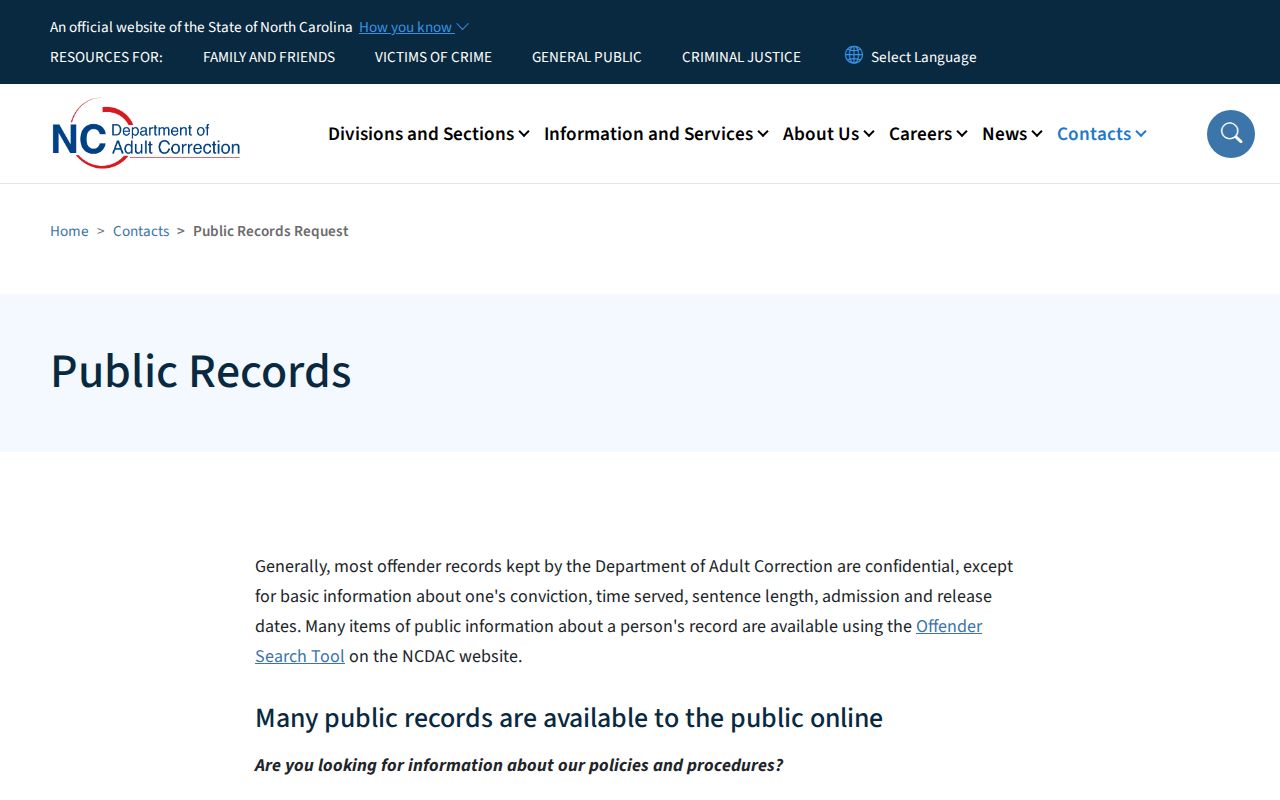
NCDAC states that most offender records are confidential, while basic conviction, time-served, sentence-length, admission, and release-date information is public. OPI and other online sources come first. If the required field is absent, use the NCDAC Public Records page and its web form. Describe the existing record rather than asking the agency to perform an analysis.
A focused request can seek releasable admission, movement, actual release, release-type, and supervision start or end records for a named person and offender number. Add a date range and ask whether the exit was recorded as community release or transfer. Chapter 132 does not require a requester to state a purpose, but specific confidentiality rules still control. The research identifies no universal fee or fixed response time, so none should be promised.
NCDAC is not the place to request a county jail record or a certified court disposition; those requests go to the sheriff or regional jail and the filing-county clerk.
North Carolina Chapter 132 requires inspection at reasonable times and copies as promptly as possible, subject to specific exceptions. It allows an agency to provide online access and does not require a requester to state a purpose. Public and confidential material can be separated through redaction. Ask for the legal basis if a field is withheld, and keep the response date because portal records and custody statuses can change.
Former offenders seeking their own prison medical records have a special NCDAC medical-record route listed on the agency’s public-records guidance. That channel is not a general-public shortcut to confidential health data. Likewise, Commission case-review files can carry confidentiality protections even though monthly discretionary-review results are publicly posted. Match the request to the record category and responsible office.
A useful response can still be limited. It may confirm an admission, a movement, an actual release date, and the start or end of supervision without disclosing internal classification, medical, security, or investigative material. That distinction should not be described as an incomplete search failure. It reflects the boundary between public OPI facts and protected corrections records.
For ongoing supervision, use the office named in OPI and confirm it through the statewide Community Supervision directory. The directory is safer than freezing a staff name because boundaries and personnel change. For an older parole review, the Commission is the correct process authority. For a federal transfer, follow BOP or the receiving agency. Each handoff keeps the NCDAC actual release or movement in context without claiming that the person is free of every other legal restraint.
Keep a simple audit trail for any NCDAC offender search result: search terms, offender number, selected status filter, incarceration period, actual or projected date, release type, supervision label, and access date. If a later result changes, the saved details show which official field changed and when. That is more precise than treating a portal screenshot as a permanent certificate of discharge. Preserve the exact agency wording.